

Sébastien Lachaussée & Elisa Martin-Winkel
A first coproduction treaty for series
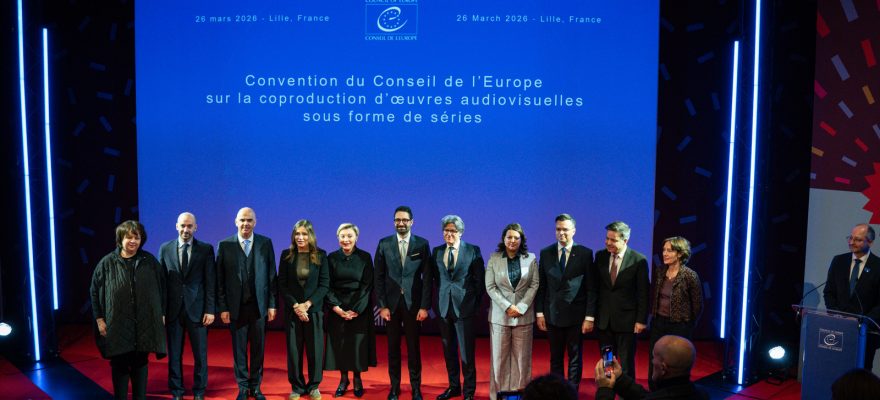
On March 26, 2026, during the latest Séries Mania festival, 9 first countries signed the Council of Europe’s Convention on the co-production of audiovisual works in the form of series. Although the Convention will not enter into force until it has been ratified by three signatory countries, it already represents a significant step forward for European audiovisual production.
In fact, the Convention establishes a regulatory framework pour international co-production, an area that had not previously been covered by a multiparty agreement.
Official co-productions are eligible for national financial funds granted for the production and broadcast of series in each co-producing country – opening up broader funding opportunities and thereby fostering international collaboration.
Below, we review the main criteria for the eligibility of an audiovisual series under the Convention and the opportunities for international funding that it may facilitate.
- Works involved and producers’ status
The Convention applies to “audiovisual works in the form of series” and thus refers to a scripted fiction work, a documentary or an animated work, presented in a series of episodes, regardless of their length, intended to be made available to the public through linear or non-linear means by a media service provider. It thus covers all genres and formats and allows a broad scope of application.
The Convention benefits “independent co-producers” and specifies that at least one independent co-producer must be the initiator of the series – that is, it must be initiated and developed by the producer. This does not exclude a series if a media service provider is a co-initiator alongside independent co-producers, but it does exclude “pure” commissions initiated solely by a broadcaster.
The conditions for independence are determined in accordance with the national law of the co-producer or, failing that, as specified in the Convention.
Thus, a company is considered independent if :
- the company is not majority-controlled, directly or indirectly, by a media service provider;
- the company does not depend exclusively or to a large extent on a single media service provider or a group of media service providers for the financing of its works;
- it assumes responsibility for the delivery of its work and can make decisions regarding broadcasting by engaging various stakeholders.
- Co-production structure, producers’ rights
The Convention sets forth rules regarding the structure of co-productions, depending on whether they are bilateral or multilateral:
- The share allocated to non-signatory parties may not exceed 30 %.
- In the case of a bilateral co-production, the minimum financial contribution may not be less than 10 % and the maximum financial contribution may not exceed 90 % of the total production cost of the series.
- In the case of a multilateral co-production, the minimum financial contribution may not be less than 5 % and the maximum financial contribution may not exceed 80 % of the total production cost of the series.
Typically, a co-production agreement must guarantee the Parties a share of the ownership rights to the series, taking into account their respective financial contribution and their creative and technical contributions.
To ensure that independent producers play a leading role, their participation must include meaningful technical and artistic involvement, and admission criteria in the form of point systems are specified to ensure that there is sufficient participation from signatory countries.
Furthermore, it is expressly specified that independent producers must be responsible for making key creative and production decisions.
- European aid for series’ production
The Convention complements the pilot program for series production – which organizes financial support.
The eligibility criteria for financial support are similar to, and in some cases identical to, the terms of the co-production Convention.
The fund is intended for independent producers, the share held by co-producers who are not members of Eurimages is capped at 30 %, independent co-producers, in each co-producing country, must hold at least 5 % of the rights. Recipients also agree not to transfer the rights to the series to third parties for at least 12 months following the first broadcast.
The fund is available to projects for which funding has already been secured and covers at least 60 % of the total cost at the time of application. The series in question must have genuine potential for international distribution.
Established a few years ago, this fund regularly issues calls for proposals to support fiction, documentary or animated series that are part of international co-productions. In 2026, an envelope of €2.1M was available, with grants ranging from €150,000 to €300,000.
The fund may cover up to 25 % of the total production costs for season, on the express condition that the submitted projects demonstrate meaningful artistic collaboration between the co-producing countries – a criterion that is also specified in the co-production Convention.
While it is still too early to gauge the impact of the co-production Convention, it is already clear that it will lead to a restructuring of relationships between co-producers and between producers and broadcasters, which will require adjustments to contractual practices. In this context, it is wise to seek the advice of an expert to determine the most advantageous structure.
SHARE THIS ARTICLE
CONTACT
OUR OFFICES
INFORMATION
sl@avocatl.com
PHONE
+33.1.83.92.11.67
Address
11 rue Sédillot
75007 Paris
Follow us :
Newsletter
Please enter your e-mail :